
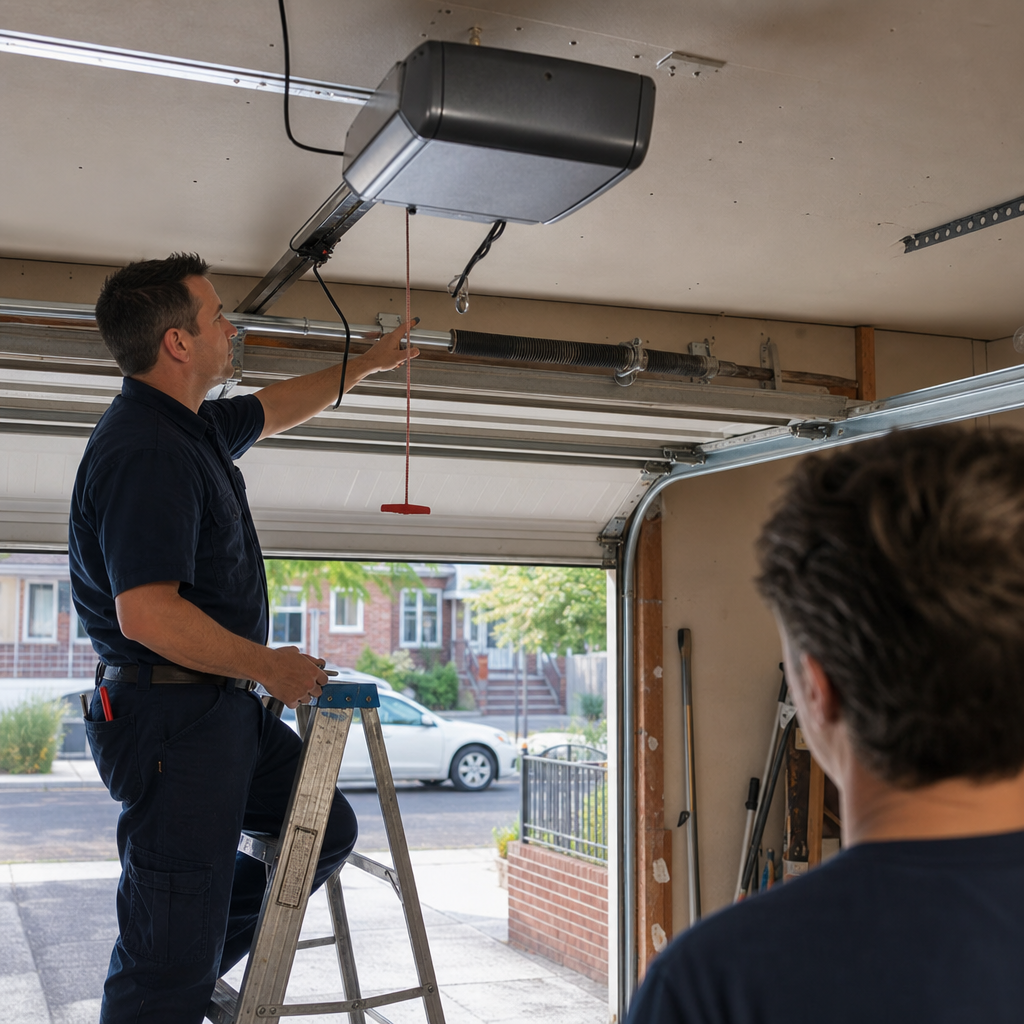
Why Does My Garage Door Reverse in New York, NY?
A garage door that reverses before fully closing is almost always responding to one of three signals: misaligned or blocked safety sensors, incorrect travel limit settings, or excessive resistance detected by the opener’s force sensor. In New York’s older housing stock — where door frames settle, sensors collect street-level grime, and uninsulated garages swing 40 degrees between seasons — the cause is rarely random. Once you know when the reversal happens, you know where to look. If you’d rather have Joseph Taylor diagnose it in person, call (888) 402-9497 for a free, no-pressure assessment.
There’s a difference between a door that reverses before it hits the floor, one that reverses after it hits something, and one that reverses randomly halfway down. Those are three different problems. Most guides treat them as one. After 17 years of working garage doors across all five boroughs — from pre-war co-op garages in the Upper West Side to new construction in Long Island City — we’ve learned that the timing of the reversal tells you nearly everything you need to know. Tell me what it’s doing — or not doing — and I’ll tell you what it needs.
What Reversal Timing Reveals: A New York Diagnostic Framework
Joseph Taylor, our owner and lead technician, grew up in Woodside, Queens, about a mile from the elevated 7 train, in a neighborhood where everybody knew the guy who fixed things and nobody wasted money on problems they could solve themselves. That mindset still drives how we approach a reversing door. We don’t start by replacing parts. We start by watching the door’s behavior and matching it to the most likely cause.
Reverses Before Ground Contact: Check Sensors and Limits First
When a door travels most of the way down, then shoots back up without touching anything, the opener’s logic board believes it has encountered an obstruction. The most common culprit in New York is photo-eye sensor misalignment — and here, local conditions matter more than most homeowners realize.
In uninsulated below-grade garages common in brownstone Brooklyn, pre-war Manhattan buildings, and parts of the Bronx, temperature swings between summer and winter cause door frames to expand and contract. We’ve seen LiftMaster and Chamberlain sensors — which rely on tight infrared beam alignment — drift out of position by just 1/8 inch, enough to trigger false obstruction readings on cold January mornings when the frame contracts. The door worked fine in October; by February, it’s reversing every third cycle.
Before adjusting anything, check three things:
- Are both sensor LEDs lit and steady? A flickering or dim light on one side almost always means misalignment.
- Is the lens clean? In NYC garages where sensors sit close to sidewalk level, we’ve found reversal caused by spider webs and fine street grit coating the lens — a problem no brand troubleshooting guide mentions, but we see it monthly in ground-floor Park Slope and Harlem garages.
- Does the reversal happen at the same point every time? Consistent reversal height points to a travel limit setting, not a sensor issue.
If the sensors are aligned and clean but the door still reverses before the floor, the close limit setting may be set too aggressively. The opener thinks the floor is an obstruction because it hasn’t been taught where “closed” actually is. LiftMaster and Chamberlain units adjust this through a different process than Genie and Craftsman models — on the former, you’re typically working with a travel module or limit switch; on the latter, often a screw-labeled “CLOSE LIMIT” or digital menu. Knowing which manual to pull saves twenty minutes of frustration.
Reverses at Ground Contact or After Hitting the Floor
A door that reaches the floor, seems to settle, then bounces back up is telling a different story. The opener’s force sensor detects resistance at the very end of travel — more resistance than the setting allows — and interprets that as something blocking the door.
In New York, this often traces to:
- Floor debris or ice buildup: Especially in garages with direct street access in Queens and the Bronx, where slush and grit get tracked in. A small ridge of frozen salt can add enough resistance to trigger reversal.
- Worn or compressed bottom seal: As the rubber hardens, it creates more friction against the floor. We’ve replaced seals on 1920s-era garage doors in Jackson Heights where the original seal had turned to plastic-like crust.
- Close-force setting too sensitive: The opener is doing its job — it’s just calibrated for a lighter door than yours, or a door that used to move more freely before rollers and hinges aged.
The close-force adjustment is generally safe for a homeowner to tweak in small increments, but there’s a critical caveat: setting it too high defeats the safety system. If a child or pet is under that door, you want the opener to reverse. We recommend testing any adjustment with a 2×4 board laid flat — the door should reverse on contact. If it doesn’t, the force is set too high and needs professional recalibration.
Reverses Randomly Mid-Travel: Binding, Board Issues, or Temperature Drift
This is the most frustrating pattern because it’s intermittent. The door reverses at 2 PM on Tuesday, works fine Wednesday morning, reverses again Thursday evening. In our experience across New York, mid-travel reversals point to one of three causes:
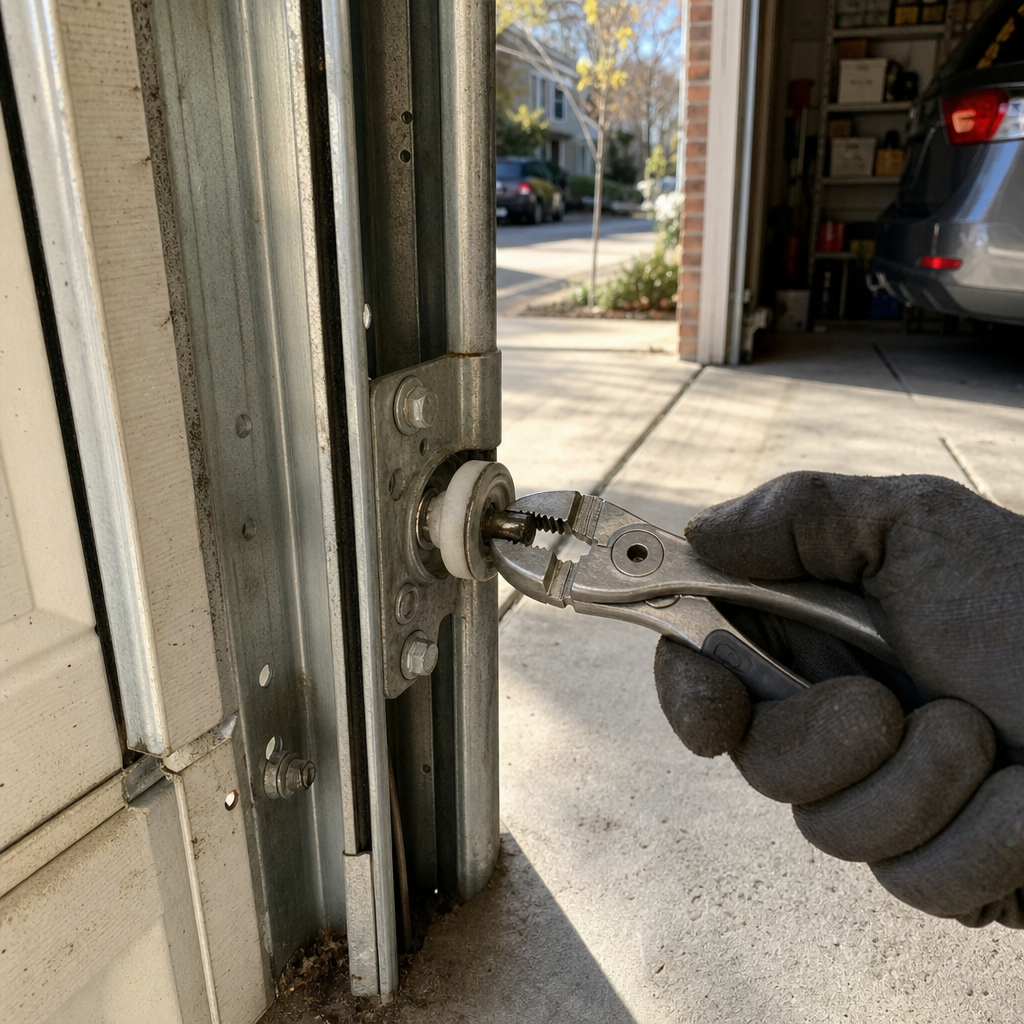
Trolley binding or track deformation: The door hangs up at a specific point in its travel, the motor strains, and the force sensor trips. This often happens where horizontal and vertical track sections meet, or where a track bracket has loosened, which is why Garage Door Off Track Repair in New York, NY is one of our most common calls. In older Manhattan garages with low headroom, the tight radius of the curved track section is a common binding point — especially if a previous installer used a universal track kit rather than one spec’d for the space.
Logic board inconsistency: The opener’s control board processes sensor input, limit position, and force readings. When components age — particularly in openers exposed to temperature swings — the board can misread a normal signal as an obstruction. We’ve replaced logic boards on 10-year-old Craftsman units in Astoria where the board worked fine in stable temperatures but threw random reversals during shoulder seasons.
Sensor drift under thermal stress: This is the NYC-specific issue we mentioned earlier. In garages with significant temperature variation, the sensor mounting brackets expand and contract at different rates than the door frame. By late winter, a sensor that was square in October can be canted just enough that vibration from the moving door breaks the beam intermittently. The reversal seems random because it depends on door speed, frame flex, and temperature — all variables.
When Reversal Is Safety Working Correctly vs. When It’s a Problem
Not every reversal is a malfunction. The auto-reverse feature, federally mandated since 1993, has saved countless injuries. Here’s how to tell the difference:
| Behavior | What It Means | Homeowner Action | When to Call |
|---|---|---|---|
| Door reverses when object is placed in path | Safety system working as designed | None needed | Only if it fails this test |
| Door reverses consistently at same height, no obstruction | Check sensors, test with 2×4 board | If adjustment doesn’t resolve | |
| Door reverses randomly, no pattern | Binding, board issue, or thermal drift | Visual inspection of track | Recommended — intermittent issues worsen |
| Door reverses only in cold weather | NYC thermal drift or hardened seal | Check sensor alignment, seal condition | If seasonal pattern persists |
The 2×4 test is the standard: place a board flat on the floor in the door’s path. A properly functioning opener should reverse the door on contact. If it doesn’t, the close-force is set dangerously high. If it reverses before contact, the travel limit is set short. Both conditions warrant attention — the first for safety, the second for function.
What Repair Costs Look Like in New York
Most reversing-door issues fall into adjustment or minor repair territory, but when components have failed, here’s what New York homeowners typically invest:
| Service | Typical Range | Common For Reversing Doors |
|---|---|---|
| Sensor realignment / cleaning | $140–$285 | Misaligned or dirty photo eyes |
| Travel limit / force adjustment | $140–$285 | Limit or force setting correction |
| Sensor replacement (pair) | $175–$380 | Damaged or obsolete sensors |
| Logic board replacement | $295–$590 | Intermittent electronic failure |
| Track realignment / repair | $140–$285 | Binding causing mid-travel reversal |
| Opener repair (general) | $140–$380 | Motor or drive issues |
| Opener installation | $295–$650 | Unit beyond repair, upgrade needed |
We don’t charge for the diagnostic visit if you proceed with repair — and for simple adjustments, Joseph Taylor has resolved reversing doors in under twenty minutes. For perspective, our full Garage Door Repair service range in New York runs $175–$710 for most residential issues.
Brand-Specific Nuance: What Manual to Pull
One thing that separates experienced technicians from guesswork is knowing that not all openers adjust the same way. If you’re troubleshooting before calling, here’s the logic:
LiftMaster and Chamberlain (including most Craftsman units built by Chamberlain): Travel limits are typically set via a travel module with up/down arrow buttons and a “SET” or “LEARN” button, or through a purple/yellow learn button system on newer models. Force adjustments are usually separate dials or digital settings. The manual will reference “travel” and “force” as distinct menus.
Genie: Older screw-drive units use physical limit switches with a “SET LIMITS” procedure involving the wall button and opener light flashes. Newer chain/belt drives use a digital display or button sequence. Force settings are typically labeled “DOOR” or “FORCE” and adjust separately.
Raynor: Often built on Chamberlain or LiftMaster chassis, so the procedure aligns with those brands — but the model number prefix tells you which manual applies. We’ve seen confusion when a Raynor-branded unit needs Chamberlain documentation.
Knowing which family your opener belongs to saves time and prevents the wrong adjustment. If you’re not certain, Joseph Taylor carries documentation and direct experience across all eight major brands we service — LiftMaster, Chamberlain, Genie, Clopay, Amarr, Wayne Dalton, Craftsman, and Raynor — so we don’t guess.
FAQs
Most reversing-door repairs in New York cost between $140 and $380, with simple sensor realignments or limit adjustments at the lower end and logic board replacement at the higher end. For the Best Garage Door Repair in New York, NY, we keep parts stocked for same-day fixes. If the opener itself needs replacement, expect $295–$650 for installation. Call (888) 402-9497 for an exact quote — estimates are free.
You can safely check for obstructions, clean sensor lenses, and verify that nothing blocks the door’s path — but we recommend against DIY adjustment of spring tension, force settings, or electrical components. A misadjusted close-force setting can make your opener dangerous, and garage door springs under tension can cause serious injury. If cleaning and visual inspection don’t resolve the reversal, call a professional. For a no-pressure assessment in New York, (888) 402-9497.
Temperature-related reversal in New York typically means sensor drift from frame contraction, thickened lubricant creating resistance, or a hardened bottom seal. In uninsulated below-grade garages common in brownstones and pre-war buildings, we’ve seen LiftMaster and Chamberlain sensors shift alignment by winter due to thermal expansion cycles. The fix is usually sensor realignment and possibly bracket reinforcement — not a new opener. Call (888) 402-9497 to schedule before the problem worsens.
For openers under 12 years old with a single failed component — logic board, gear assembly, or capacitor — repair is typically more economical at $140–$380. Replacement becomes the better value when multiple systems fail, parts are obsolete, or the unit lacks modern safety features. We carry parts for all eight major brands, so we can offer either path honestly. For a frank assessment of your specific opener, call (888) 402-9497.
When to Call Matrix Garage Door Repair New York
If you’ve checked the sensors, cleared the track, and the door still reverses unpredictably, the problem likely requires hands-on diagnosis. Joseph Taylor shows up personally — not a subcontractor, not a trainee — with 17 years of garage door problems solved and the parts inventory to fix most issues same-day. 411 neighbors have trusted us, and we work on your brand, whatever it is.
If you’d rather have it looked at, Matrix Garage Door Repair New York offers a no-pressure assessment in New York — call (888) 402-9497.
Written by Joseph Taylor, Owner & Lead Technician at Matrix Garage Door Repair New York, serving New York, NY.