
New Garage Door Installation Cost in New York: What You’ll Actually Pay in 2024
In New York, a new garage door installation typically runs $825–$2,595 depending on door size, material, and whether your existing opening needs modification. Most standard single-car steel doors with basic opener compatibility fall in the $1,100–$1,600 range installed. Call (888) 402-9497 for a free, on-site estimate — we bring samples and measure everything in person.
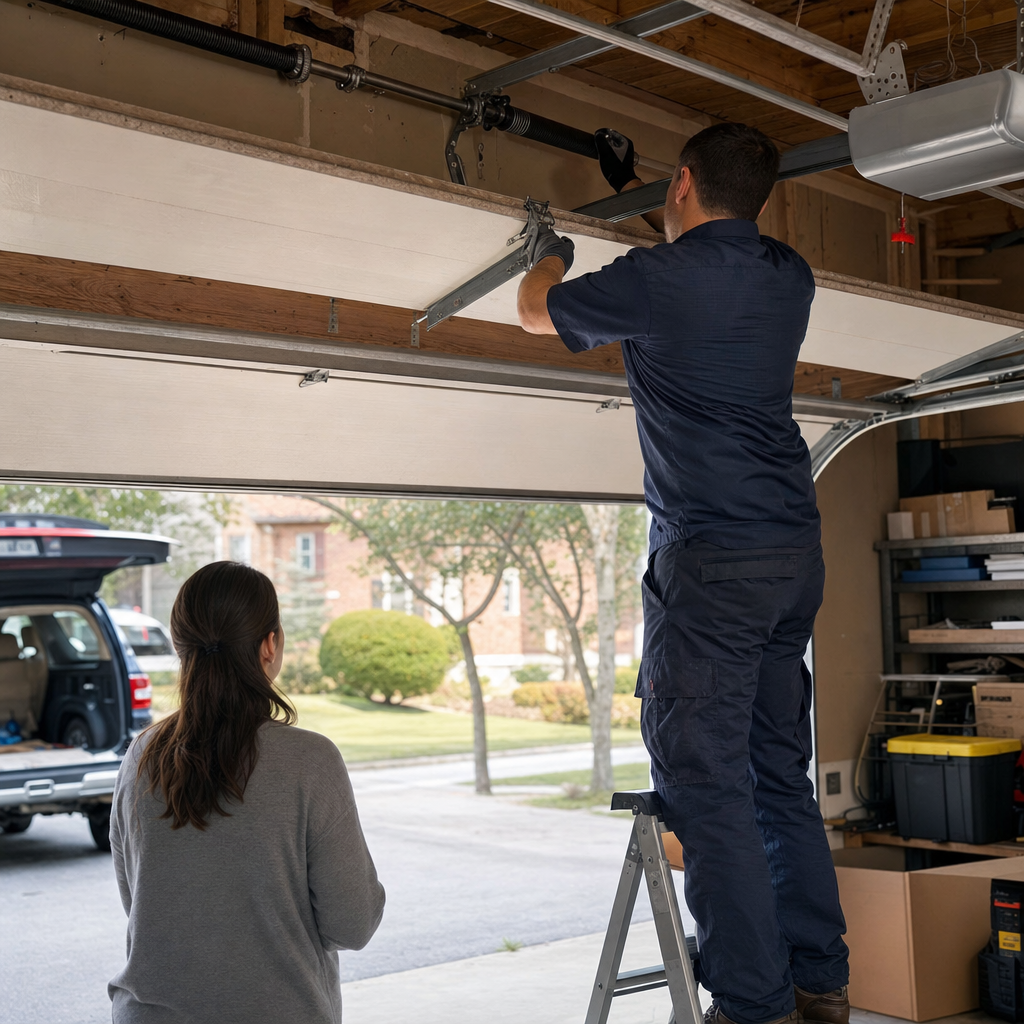
That $1,200 door you see quoted on national sites assumes a standard rough opening, a flat driveway, and a delivery truck that can park in front of the house. In Astoria or Cobble Hill, one or all three of those assumptions is wrong. We’ve been installing doors across all five boroughs for 17 years, and the gap between internet estimates and actual New York invoices is where most homeowners get surprised.
Why NYC Installation Costs Don’t Match National Guides
Joseph Taylor, our owner and lead technician, grew up in Woodside, Queens — about a mile from the elevated 7 train — in a neighborhood where everybody knew the guy who fixed things and nobody wasted money on problems they could solve themselves. That background shapes how we quote jobs: no padding, no surprises, but also no pretending that installing a 16-foot door on a Park Slope carriage house is the same as a suburban ranch in New Jersey.
Three factors consistently push New York installations above national averages:
- Delivery and access premium: Door panels are large and heavy — a standard 16×7 steel door ships in 3-4 sections, each weighing 80-120 pounds. In dense residential neighborhoods, delivery trucks can’t always double-park legally, and stairwell or alley access to rear garages adds labor time. This staging challenge typically adds $150–$400 to jobs that national calculators don’t model.
- Non-standard rough openings in prewar housing: Many garages built before 1950 — common in Brooklyn Heights, Jackson Heights, and the Upper West Side — have openings 2-4 inches off standard sizing. Header or jamb modification is required before any door goes in. We’ve seen openings in 1920s brownstones that needed full reframing; we’ve also seen jobs where shimming solved it in 20 minutes. Either way, an honest New York quote accounts for this possibility.
- Permit and inspection coordination: NYC Department of Buildings requirements vary by borough and building type. Attached garages in one- and two-family homes may need type approval documentation for the door assembly. We handle this paperwork, but the time involved is real.
What Drives Price Within That $825–$2,595 Range
The table below breaks down where your money goes. These are installed prices for New York properties, including standard hardware, tracks, and basic weatherseal — not the door alone.
| Component / Scenario | Price Range |
|---|---|
| Single-car steel door (8×7), uninsulated, standard opening | $825–$1,195 |
| Single-car steel door (8×7), polyurethane insulated | $1,100–$1,495 |
| Double-car steel door (16×7), insulated, standard opening | $1,350–$1,895 |
| Double-car with windows or carriage-house panel design | $1,650–$2,295 |
| Aluminum full-view or custom wood overlay | $1,950–$2,595 |
| Opening modification (header/jamb — prewar buildings) | $200–$650 |
| NYC delivery/access premium (dense blocks, rear garages) | $150–$400 |
| Opener installation (separate from door) | $295–$650 |
| Disposal of existing door and hardware | $75–$150 |
We don’t quote by phone and hope for the best. Joseph Taylor shows up personally, measures the opening, checks headroom and sideroom clearance, and identifies whether your garage has the structural conditions for the door you want. “Tell me what it’s doing — or not doing — and I’ll tell you what it needs.” That applies to existing door problems, but it also applies to new installations: tell us what you’re working with, structurally and aesthetically, and we’ll tell you what fits and what it costs.
Material Choice and NYC’s Freeze-Thaw Reality
New York’s climate punishes the wrong door selection. We see this most clearly in garages attached to heated living space — common in row houses and brownstones throughout Brooklyn and Queens.
Uninsulated steel doors create thermal bridging: the cold metal skin becomes a heat sink in January, and condensation forms on the interior surface. By March, that moisture has rusted bottom brackets and degraded bottom seals we’ve installed on other doors. For attached garages, we spec polyurethane-insulated steel with an R-value of 12-18. The upfront cost runs $250-400 higher than uninsulated, but the door lasts longer and your heating bill reflects the difference.
For detached garages in neighborhoods like Bayside or City Island, where the door isn’t affecting heated space, uninsulated steel is often the right call. We carry both and don’t upsell insulation where it doesn’t pay.
Brand Comparison: What Actually Matters in NYC
We’re certified on eight major brands — Clopay, Amarr, Wayne Dalton, Raynor, LiftMaster, Chamberlain, Genie, and Craftsman — and we install 4 of those door lines regularly in New York. Here’s how they sort for specific NYC scenarios:
Clopay dominates our installations for a reason: their Intellicore polyurethane insulation performs well in freeze-thaw, and their Gallery and Canyon Ridge collections suit brownstone and townhouse curb appeal without the maintenance burden of actual wood. We install more Clopay doors in Park Slope and Fort Greene than any other line.
Amarr offers comparable insulation values at slightly lower price points, with stronger distribution in the Northeast — meaning faster replacement part availability if a panel gets damaged. For rental properties in Astoria or Washington Heights where landlords prioritize durability and parts accessibility, Amarr often wins.
Wayne Dalton and Raynor both make excellent doors, but their distribution networks are thinner in the metro area. We install them when a customer specifically requests the brand or when architectural review boards in co-op buildings mandate a particular aesthetic match. Otherwise, the longer lead times for specialty parts become a liability in a city where a broken door is a security problem.
On the opener side, LiftMaster and Chamberlain are our standard recommendations — they’re what we service most, parts are available same-day from Queens distributors, and their myQ smart connectivity works reliably in dense RF environments where cheaper openers drop signal.
Common Local Scenarios We See
Every installation tells a story about the building. Here are four we encounter repeatedly:
The prewar Queens garage with the “mystery” opening. In Sunnyside and Woodside, 1920s and 1930s garages often have 7-foot-4-inch openings or headers that sag half an inch in the center. We measure three points across the width and check plumb on both jambs. If the opening’s out of square, we quote the reframing before we quote the door — no surprises on install day.
The Brooklyn brownstone carriage house with curb-appeal pressure. These doors face the street directly; they’re part of the facade. Homeowners in Cobble Hill and Carroll Gardens often want carriage-house panel designs with decorative hardware. We bring sample panels to the estimate so you see the actual shadow lines and color in your specific light, not on a screen.
The Manhattan co-op with board approval requirements. Upper East Side and Upper West Side buildings often require color matching, noise specifications, or specific safety certifications. We handle the documentation — wind-load ratings, fire separation details if applicable — and coordinate with building management for access.
The Staten Island detached garage with headroom constraints. Older garages in Tottenville or Great Kills were built with 8-inch or 10-inch headroom, insufficient for standard track hardware. Low-headroom track kits or wall-mounted jackshaft openers (LiftMaster 8500W series) solve this. We identify the constraint during measurement and spec the right hardware from the start.
Why Owner-Operator Pricing Is Different
Because Joseph handles the full job — measurement, ordering, installation, and final adjustment — there’s no margin-stacking between a sales rep’s quote and what the installer actually charges. National chains and multi-location operations often subcontract installation crews who bid low and rush jobs to hit volume. We’ve cleaned up after those installations: tracks bolted to rotting jambs, openers mounted with lag bolts that pulled out of compromised header framing, safety sensors positioned where the door won’t reverse on a child’s bike.
Our pricing reflects one experienced technician doing the job correctly, not a dispatcher sending whoever’s available. 411 neighbors have trusted us — not a handful of curated testimonials, but 411 verified reviews averaging 4.8 stars that document consistent, repeatable work.
From a Broken Spring to a Full New Door
Our full-service scope means we don’t walk away from structural problems we discover during installation. If your header is compromised, your jambs are rotted, or your concrete is spalling where the vertical track mounts, we handle it. No sourcing parts from a third party, no calling a second contractor. This matters because the cheapest installation quote often assumes perfect conditions — and New York buildings rarely offer perfect conditions.
We also maintain existing doors and openers across all eight brands we service. If you’re not sure whether replacement is necessary, we’ll tell you honestly. We’ve repaired 17-year-old doors that had another five years in them, and we’ve recommended immediate replacement on doors that looked fine but had dangerous spring or cable conditions. The diagnosis is free; the honesty is part of the estimate.
FAQs
Expect $825–$2,595 installed, with most standard insulated steel doors for single-car garages falling between $1,100–$1,600. The upper end covers custom materials, non-standard openings requiring framing modification, or difficult access in dense neighborhoods. Call (888) 402-9497 for an exact quote — estimates are free and include on-site measurement.
Repair is cheaper when the door itself is structurally sound — panel replacement ($295–$590) or spring/cable work ($210–$400) extends life significantly. Replacement makes sense when the door has multiple failed panels, severe rust, or an outdated opener system that lacks modern safety features. We’ll assess your specific door and give you both numbers so you can decide.
Same-day installation is possible for standard sizes if we have your door in stock, but most New York jobs require 3-7 business days for material delivery and permit coordination if needed. Emergency repair — getting a non-functional door secured and operational — is available for urgent situations. For planned replacement, the short wait ensures proper measurement and material selection.
National averages assume standard rough openings, ground-level delivery, and suburban access. In New York, delivery trucks face parking restrictions, prewar buildings have non-standard openings, and attached garages often require insulated doors for thermal performance. These aren’t upsells — they’re real conditions of working in dense, older housing stock that honest pricing must account for.
Get Your Exact New Garage Door Installation Cost in New York
Ready to stop guessing and get a number that matches your actual building? Call (888) 402-9497 or schedule your free Garage Door Installation estimate online. Joseph Taylor will show up personally, measure your opening, check structural conditions, and quote the job — no pushy sales tactics, no hidden fees, just 17 years of garage door problems solved honestly. We serve all five boroughs and carry the full range of garage door services from emergency repairs to complete new installations.
Written by Joseph Taylor, Owner & Lead Technician at Matrix Garage Door Repair New York, serving New York, NY.