
Last updated July 10, 2026
Garage Door Parts Maintenance Checklist for New York City Homeowners
After 17 years of service calls across New York City, the single most common phrase we hear is “I didn’t even know that part existed” — and it’s almost always the part that caused a $600 repair that a $5 adjustment would have prevented six months earlier. In a city where garage doors face road salt splash-back from street traffic, concrete floor heave in pre-war buildings, and header insulation gaps that accelerate spring fatigue, the standard suburban maintenance checklist misses half the failures we see. This guide sequences every check by what actually breaks in New York City garages, not what’s easiest to inspect.
Quick Answer
New York City homeowners should inspect garage door parts every three months, with critical checks timed to November freeze-thaw cycles and April pothole-season salt accumulation. The most overlooked failure points are bottom bracket corrosion from road salt, torsion spring tension drift in poorly insulated headers, and cable drum wear from non-standard NYC headroom clearances — all of which can be spotted early with a flashlight and 20 minutes of attention.
Table of Contents
- The NYC-Specific Failure Points Most Checklists Ignore
- Seasonal Maintenance Calendar: Timing Checks to NYC Weather
- Step-by-Step Inspection Sequence for NYC Garages
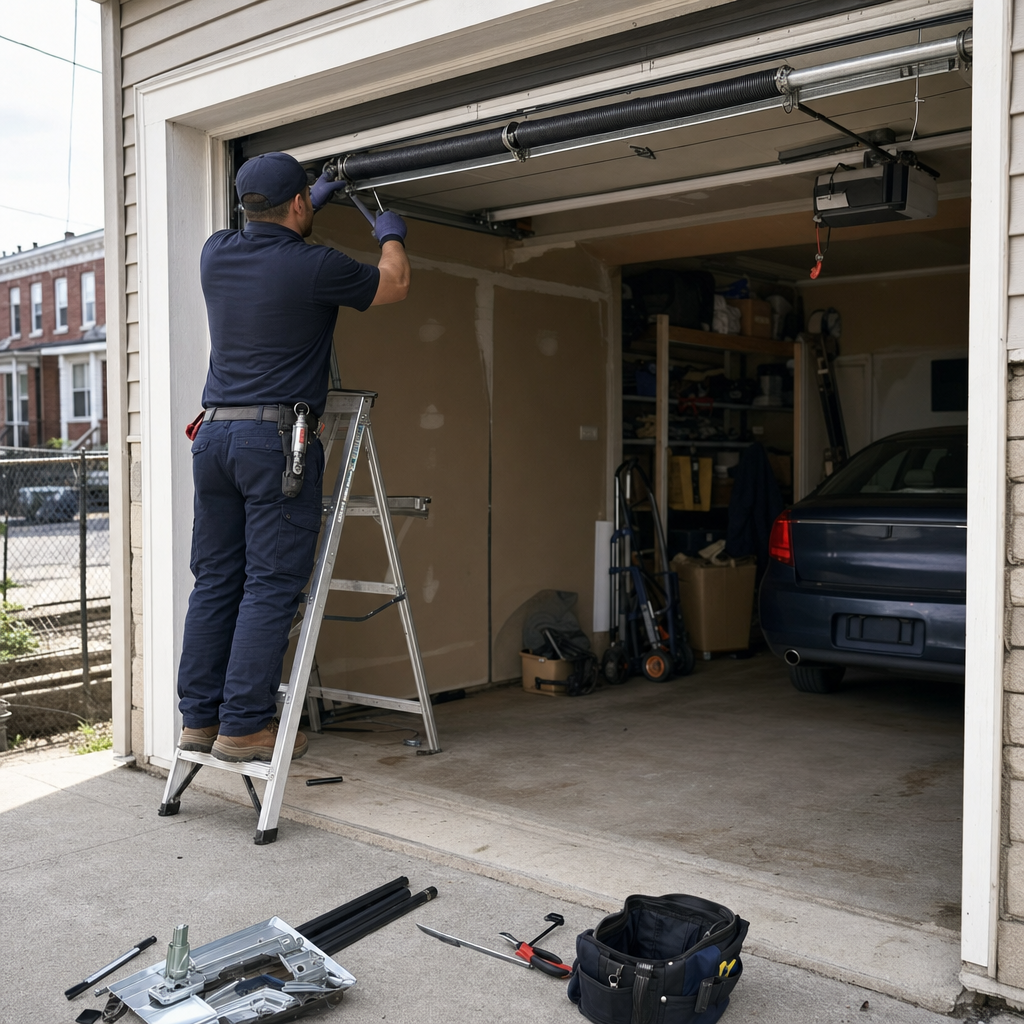
- Torsion Springs and Cables: What You Can Check, What You Shouldn’t Touch
- Opener, Track, and Hardware Checks by Brand
- Weatherstripping, Bottom Seals, and Concrete Heave Problems
- Common Mistakes to Avoid
- When to Call a Professional
- Frequently Asked Questions
The NYC-Specific Failure Points Most Checklists Ignore
Generic maintenance guides assume a detached suburban garage with standard 12-inch headroom, stable soil, and minimal chemical exposure. New York City garages operate in a different environment entirely. After servicing doors from Inwood to the Rockaways, we’ve identified four failure patterns that dominate our emergency call volume — and none of them appear on standard checklists.
Road salt and gutter runoff corrosion. In Manhattan and brownstone Brooklyn, garage doors sit directly adjacent to sidewalk salt piles and street splash-back. The bottom brackets — the L-shaped metal pieces where the track meets the door panel — corrode from the inside out. By the time you see rust on the exterior, the interior wall thickness has already degraded 40%. In Queens and the Bronx, where driveways slope toward the garage, gutter downspout misdirection accelerates this. We replace bottom brackets in New York City at roughly 3x the rate of our suburban counterparts.
Header insulation gaps and spring tension drift. Torsion springs are calibrated to a specific number of cycles at a stable temperature range. In buildings with uninsulated or poorly sealed headers — common in pre-war construction from the Upper West Side to Astoria — winter cold transfers directly to the spring tube. The metal contracts, tension increases, and the spring’s cycle rating drops by 15-20%. More critically, the uneven heating pattern creates micro-stress fractures that aren’t visible until the spring snaps.
Non-standard headroom and cable drum wear. New York City garages frequently have 8-9 inches of headroom instead of the standard 12, requiring high-lift or low-headroom track configurations. Cable drums in these setups wear asymmetrically because the cable wraps at a steeper angle. We see grooved drums in Chelsea basement garages and Harlem carriage houses that were installed correctly but never inspected for the wear pattern specific to their geometry.
Concrete floor heave and seal failure. Older New York City garage slabs — particularly in buildings constructed before 1960 — experience seasonal heave from freeze-thaw cycling in the underlying soil. A door that seals properly in October may gap 3/8-inch by March. That gap admits meltwater, which re-freezes and accelerates bracket corrosion. It’s a feedback loop we break by adjusting bottom seal contact pressure seasonally, not annually.
Seasonal Maintenance Calendar: Timing Checks to NYC Weather
New York City’s continental climate creates four distinct stress windows. We schedule our own maintenance reminders around these dates, and we recommend homeowners do the same.
Early November: Pre-Winter Freeze Prep
Before the first sustained freeze — typically the second week of November in New York City — check bottom bracket corrosion status, verify header insulation integrity, and confirm bottom seal contact across the full width. This is also when we test opener force settings; cold-stiffened weatherstripping increases resistance, and an improperly calibrated opener will strain its motor or reverse incorrectly.
Mid-January: Deep Winter Stress Check
After 6-8 weeks of freeze-thaw cycling, inspect for new concrete heave patterns and salt accumulation at the door base. In brownstone Brooklyn and the West Village, where street salting is aggressive, we see peak bracket corrosion calls in late January. A flashlight check of bracket interiors now prevents a February failure.
Late April: Post-Pothole-Season Salt Flush
Road salt residue that accumulated over winter gets reactivated by spring rain. Flush the door base with fresh water — not pressure-wash, which forces water into bearings — and inspect roller stems for corrosion bloom. This is our highest-volume replacement season for rollers in coastal Queens neighborhoods where salt air compounds street salt.
Mid-September: Pre-Heating-Season Hardware Check
Before buildings switch to heating systems that dry interior air, check all fastener torque. Seasonal humidity swings in New York City loosen track bolts and opener mounting hardware more than in climate-controlled suburban homes. We find more loose lag screws in September than any other month.
Step-by-Step Inspection Sequence for NYC Garages
This sequence prioritizes the checks that prevent the most expensive emergency calls we handle in New York City. Complete it in order; don’t skip ahead.
- Safety lockout. Disconnect the opener and clamp the door in the open position with locking pliers on the track. Never work under a door supported only by the opener carriage.
- Bottom bracket exterior inspection. With the door open, examine both bottom brackets for rust streaking, swelling, or delamination of the galvanized coating. In New York City, pay particular attention to the bracket’s interior face — the side facing the door interior — which catches salt spray from street traffic. Use a flashlight; surface rust on the exterior often masks worse corrosion inside.
- Bottom bracket fastener torque check. Attempt to turn the lag screws or through-bolts by hand. In salt-corroded brackets, the fasteners loosen as the metal substrate degrades. Do not over-tighten; if a bolt spins freely, the bracket is compromised and needs replacement.
- Roller stem and bearing rotation. Remove one roller at a time from the track and rotate the stem by hand. It should turn smoothly with faint bearing noise, not grind or catch. In New York City, we replace rollers showing any brown corrosion staining on the stem — this indicates salt infiltration that will seize the bearing within two seasons.
- Cable drum groove inspection. With the door clamped open, examine the cable drum grooves for asymmetric wear. In low-headroom NYC installations, the cable should seat in the groove’s center, not ride against either flange. A polished wear line on one flange indicates incorrect drum selection or track geometry drift.
- Torsion spring gap and coil spacing. From the side, observe the gap between adjacent coils with the door closed. Coils should maintain consistent spacing; any coil touching its neighbor indicates set loss and imminent failure. In uninsulated headers, check for condensation on the spring tube — a sign that temperature cycling is accelerating metal fatigue.
- Header seal and insulation check. Run your hand along the header framing above the spring tube. Draft or temperature drop indicates insulation gaps that transfer cold to the spring assembly. In New York City pre-war buildings, this is often the single most impactful fix for spring longevity.
- Track fastener torque and plumb. Check all track bolts and wall brackets for looseness. Verify vertical track plumb with a level; in buildings with settling foundations — common in older Queens and Brooklyn structures — track misalignment causes roller edge-loading that cracks wheels.
- Opener force and limit settings. Reconnect power and test the opener’s force sensitivity using the manufacturer procedure. In cold weather, increased door resistance from stiffened seals can trigger false obstruction reversals or, worse, override the safety system entirely. We calibrate LiftMaster and Chamberlain openers seasonally for this reason.
- Bottom seal contact pattern. Close the door on a strip of paper or thin cardboard at multiple points across the width. Consistent drag indicates uniform contact; easy pull-through indicates gaps. In New York City, check this in both November and April — concrete heave changes the contact pattern seasonally.
Torsion Springs and Cables: What You Can Check, What You Shouldn’t Touch
Torsion springs store lethal energy. A standard residential spring holds enough torque to cause serious injury or death if released improperly. We include this section because informed observation prevents emergencies — but we draw a hard line at DIY adjustment.
What you can safely check:
- Coil spacing consistency (gaps between adjacent coils should be uniform when the door is closed)
- Spring tube condensation or rust streaking
- Cable fraying, kinking, or birdcaging (strands separating from the cable core)
- Cable attachment at the bottom bracket — look for looseness, not to adjust it
- End cone integrity (the castings at each end of the spring tube; cracks here precede catastrophic failure)
Never attempt:
- Winding or unwinding a torsion spring using winding bars
- Removing a cable from a loaded drum
- Adjusting cable tension to “balance” the door
- Clamping or securing a spring tube without proper winding bars and body positioning
In 17 years, Joseph Taylor has treated injuries from two homeowners who attempted spring adjustments after watching online tutorials. Both involved broken wrists from unexpected torque release. The $150-250 professional adjustment cost — which includes proper safety equipment and liability coverage — is not worth the risk.
In New York City specifically, spring failures cluster in January and February when cold-header buildings stress the metal most. If you observe coil contact, tube condensation, or any cable irregularity, call for professional evaluation. Matrix Garage Door Repair New York home provides same-day spring assessments, and Joseph Taylor shows up personally for every call.
Opener, Track, and Hardware Checks by Brand
Not all openers age the same way in New York City’s environment. After servicing eight major brands across the five boroughs, we’ve identified brand-specific wear patterns that should inform your inspection focus.
LiftMaster and Chamberlain (belt/chain drive). These dominate New York City installations for their rail rigidity. Check the trolley and rail junction for grease hardening — summer heat in unventilated garages polymerizes the factory lubricant, and winter cold makes it brittle. We remove and re-lubricate this junction annually on units we maintain. The force adjustment dials are also more sensitive to temperature drift than screw-drive units; verify settings seasonally.
Genie (screw drive). The threaded steel rail requires specific low-temperature grease that doesn’t harden below 20°F. In New York City, we find more Genie rail seizures in January than all other brands combined because homeowners used standard lithium grease. Check rail lubricant consistency by running the opener manually — any grittiness or binding indicates grease failure. Garage Door Parts in Buffalo faces similar cold-weather grease challenges, and we apply the same protocol there.
Raynor (chain and belt systems). Raynor’s chain-tensioning mechanism loosens faster in high-cycle environments. In New York City buildings where the door sees 6-8 cycles daily — common in multi-unit conversions — check chain sag monthly, not annually. Sag beyond 1/2 inch mid-span causes opener rail flex and premature gear wear.
Track and hardware (all brands). We replace more horizontal track brackets in New York City than any other hardware category. The combination of vibration from street traffic (transmitted through building structure), humidity cycling, and occasional impact from vehicles or stored items loosens wall-mounted hardware. Check bracket bolt torque quarterly; use a socket wrench, not visual inspection.
Weatherstripping, Bottom Seals, and Concrete Heave Problems
New York City’s freeze-thaw cycle creates a maintenance problem unique to older urban garages: concrete floor heave that changes the door’s sealing geometry seasonally.
Understanding heave patterns. In pre-1960 construction — widespread in Park Slope, Washington Heights, and much of Queens — garage slabs were poured without proper sub-base preparation or expansion joints. Water infiltrates the soil beneath, freezes, and lifts the slab 1/4 to 3/8 inch. In spring, it settles back, sometimes unevenly. A bottom seal that contacts properly in October gaps in February, admitting meltwater that accelerates bracket corrosion and, in worst cases, re-freezes to lock the door shut.
Seal types and NYC suitability. Standard vinyl bulb seals work in stable environments but fail quickly under heave cycling. We install EPDM rubber seals with internal ribs for New York City garages with known heave — the ribs maintain contact across a wider compression range. For severe heave in older Brooklyn brownstone garages, we use adjustable aluminum retainer strips that allow seasonal repositioning without full seal replacement.
Inspection protocol. Close the door on a damp day and check for light infiltration from outside — any visible line indicates a gap. Feel for drafts with the back of your hand. In January and April, compare the contact pattern to your November and September checks; significant change indicates heave activity that needs management, not just seal replacement.
Side and top weatherstripping. Vinyl flap seals on the jambs and header degrade faster in New York City’s UV exposure and ozone environment than in shaded suburban settings. Check for cracking at the folds — this is where stress concentrates. Replace when cracks reach 1/8 inch depth; deeper cracks admit enough water to saturate jamb framing and accelerate hardware corrosion.
For complete door replacement in heave-prone situations, Garage Door Installation in Buffalo applies similar slab-stabilization techniques we use in New York City’s older neighborhoods.
Common Mistakes to Avoid
- Using WD-40 on rollers or bearings. WD-40 is a solvent, not a lubricant. It strips existing grease and leaves a residue that attracts street grit. In New York City’s particulate-heavy environment, this creates abrasive paste inside bearings. Use lithium-based garage door lubricant or silicone spray specifically.
- Ignoring the header insulation gap. Homeowners check springs, cables, and openers but never the framing above the door. In uninsulated headers common to pre-war New York City buildings, this single omission cuts spring life by 30% and voids most manufacturer warranties for cold-climate failure.
- Annual instead of seasonal seal checks. The standard “check your weatherstripping once a year” advice assumes stable substrate. In New York City, concrete heave changes seal contact between November and March. One annual check misses the critical winter gap period entirely.
- Pressure-washing salt residue. Spring cleaning enthusiasm drives homeowners to blast road salt from door bases. High-pressure water forces sodium chloride into roller bearings, bracket interiors, and track crevices where it continues corroding. Use low-pressure rinse and compressed air dry, or better, professional cleaning with corrosion inhibitor.
- Assuming all brands use the same maintenance protocol. Genie screw drives need different lubricant than LiftMaster chain drives. Chamberlain belt drives have specific trolley inspection points. Applying generic advice wastes time and can damage components — a mistake we correct frequently in service calls.
- Delaying professional evaluation after observing coil contact. When torsion spring coils touch, the spring has lost set and is operating beyond its design stress. Every subsequent cycle increases fracture probability. In 17 years, we’ve never seen a contacted-coil spring last another full season in New York City’s climate.
- Neglecting opener force calibration after any hardware change. New rollers, adjusted springs, or replaced cables change door operating resistance. An opener calibrated to the old resistance will either strain its motor or fail to reverse on obstruction. Recalibrate after any hardware service — this is not optional maintenance, it’s safety-critical.
When to Call a Professional
Some maintenance boundaries are about safety, others about diagnostic equipment. Call for professional service when you observe: torsion spring coil contact or any visible crack in the spring body; cable fraying, kinking, or detachment from the drum or bracket; opener reversal failure during the safety test; any bracket fastener that spins freely or shows through-corrosion; door binding or uneven travel that persists after track inspection; or concrete heave that has shifted the door frame relative to the opening.
Joseph Taylor shows up personally for every service call at Garage Door Repair in Buffalo and throughout New York City. With 17 years of garage door problems solved and certification across LiftMaster, Chamberlain, Genie, and five additional major brands, we diagnose systems that generalist contractors misidentify. 411 neighbors have trusted us with their garage door service — from a broken spring to a full new door, one company handles the whole job.
Matrix Garage Door Repair New York offers free estimates in New York City. Call (888) 402-9497 to schedule an inspection or discuss any observation from this checklist.
Frequently Asked Questions
Inspect your garage door parts every three months, with critical checks timed to November freeze-thaw onset and April salt-flush season. New York City’s combination of road salt, concrete heave, and pre-war building stock creates failure modes that annual inspection misses entirely. Call (888) 402-9497 to add professional seasonal service to your own checks.
You can apply light lubricant to torsion spring coils from a safe distance using the manufacturer-recommended product, but never touch a loaded spring or attempt to adjust tension. Cables should be inspected for fraying but not lubricated — grease attracts grit that accelerates internal wear. For spring maintenance requiring winding bar access, hire a trained technician; the stored energy is lethal.
Concrete floor heave from freeze-thaw cycling lifts the slab beneath your door during cold months, changing the seal contact geometry. This is common in New York City garages built before 1960 with inadequate sub-base preparation. The solution isn’t thicker seal material but adjustable retainer hardware or seasonal repositioning — techniques we apply regularly in brownstone Brooklyn and pre-war Manhattan buildings.
Professional multi-point inspection and adjustment typically runs $120-$200 for standard residential doors in New York City, with spring tension calibration adding $80-$150 if needed. Emergency service for failures prevented by maintenance costs $300-$600 plus parts. The maintenance cost pays for itself on the first prevented emergency call. Call (888) 402-9497 for exact pricing on your specific door configuration — estimates are free.
Repair is more economical when the door panel is intact, the track system matches standard geometry, and no more than two major components need replacement. Replacement becomes cost-effective when panels are dented or corroded, the track requires custom fabrication for non-standard NYC headroom, or cumulative repair estimates exceed 60% of installed replacement cost. Joseph Taylor provides both options with upfront pricing — no pressure toward either solution.
We maintain working knowledge and parts availability across eight major brands: LiftMaster, Chamberlain, Genie, Clopay, Amarr, Wayne Dalton, Craftsman, and Raynor. This covers approximately 95% of installed residential systems in New York City. For discontinued or import brands, we source compatible hardware or advise on replacement timing. Call (888) 402-9497 with your model number for confirmation.
The Bottom Line
New York City garage doors fail differently than suburban systems — road salt corrodes hidden brackets, pre-war headers freeze springs from above, and concrete heave changes seal geometry seasonally. A maintenance checklist that ignores these realities prevents only the failures that were unlikely anyway. Inspect every three months using the sequence above, time critical checks to November and April, and respect the safety boundaries around torsion springs. The 20 minutes of informed observation this guide describes will prevent the majority of emergency calls we handle — and the ones you can’t prevent, Joseph Taylor handles personally, with 17 years of experience and the parts inventory to fix it in one visit.
Written by Joseph Taylor, Owner & Lead Technician at Matrix Garage Door Repair New York, serving New York City since 2009.