
Last updated July 10, 2026
The Complete Guide to Garage Door in New York City
New York City has more garage doors than most people realize — and a higher rate of premature failure — because owners keep buying products rated for suburban Ohio climates and installing them in buildings that were never designed for them. In 17 years of walking into carriage houses in Brooklyn Heights, co-op garages on the Upper East Side, and mixed-use buildings in Long Island City, we’ve seen the same pattern: a door that should last 15 years failing in 7 because someone ignored the freeze-thaw math, the salt-air corrosion, or the structural load of a 1920s brownstone header. This guide maps the specific realities of owning, maintaining, and replacing garage doors in New York City’s unique built environment — so you stop using advice that doesn’t survive contact with a February nor’easter or a co-op board’s alteration agreement.
Quick Answer
Garage door ownership in New York City requires choosing materials and insulation rated for coastal freeze-thaw cycles, confirming co-op or condo board approval before ordering replacement doors, and matching hardware to actual daily cycle counts rather than residential-grade assumptions. Most premature failures we see in New York City trace back to one of these three mismatches between generic product specs and local conditions.
Table of Contents
- Why NYC’s Climate Destroys Standard Garage Doors
- Co-op and Condo Board Requirements That Kill Projects
- Residential vs. Commercial-Grade Hardware for High-Cycle Buildings
- How to Read Your Building’s Original Garage Structure
- The Aggregator App Trap: Hiring Mistakes NYC Homeowners Make
- A Realistic Maintenance Schedule for New York City Conditions
- When to Repair vs. Replace: A NYC Decision Framework
- Common Mistakes to Avoid
- When to Call a Professional
- Frequently Asked Questions
Why NYC’s Climate Destroys Standard Garage Doors
The garage door industry tests products against a national average that doesn’t include January weeks where the temperature swings from 8°F to 48°F in 72 hours — a routine event in New York City. Those freeze-thaw cycles expand and contract metal components at different rates, stressing springs, cables, and track alignment in ways that suburban Kansas test data never captures.
Salt-air corrosion accelerates everything. In coastal Queens neighborhoods like the Rockaways, Breezy Point, and parts of Staten Island’s South Shore, we’ve measured spring corrosion rates roughly 40% faster than inland Bronx locations. Standard galvanized torsion springs rated for 10,000 cycles often show pitting and stress fractures by year five. For these New York City neighborhoods, we spec oil-tempered springs or coated alternatives — a detail most national guides never mention because their authors haven’t pulled failed springs from a Sandy-flood-zone garage.
Insulation ratings matter differently here. A door with an R-value of 6 might suffice in Atlanta, but in a New York City brownstone carriage house with uninsulated masonry walls and a single-paned transom window, it’s effectively decorative. We regularly see homeowners in Park Slope and Fort Greene install R-6 doors and wonder why their heating bills don’t drop. For attached or semi-conditioned New York City garage spaces — common in converted carriage houses and modern townhome developments — we recommend minimum R-12 with thermal breaks, or R-16 if the space shares a wall with living areas.
Wind load ratings are non-negotiable near open water. NYC Building Code requires 90 mph wind resistance for garage doors in most zones, but 110 mph in coastal flood zones. We’ve had to replace doors in Sheepshead Bay and Gerritsen Beach that were installed by out-of-state contractors who didn’t check the wind speed map. The Department of Buildings (DOB) will flag this on inspection, and if you’re in a co-op, the board’s engineer will catch it before you get approval anyway.
Co-op and Condo Board Requirements That Kill Projects
Nothing wastes money faster in New York City than ordering a $4,200 custom Clopay door before reading your building’s alteration agreement. We’ve arrived at jobs in co-op buildings on Central Park West and the Upper East Side where the homeowner is staring at a palletized door they can’t install because the board requires specific color matching, window prohibition, or brand pre-approval.
Standard co-op and condo constraints we encounter:
- Color and finish matching: Many boards mandate that garage-facing doors match the building’s facade color exactly. Some specify powder-coated aluminum only, rejecting wood-composite alternatives that would actually perform better in New York City’s humidity.
- Window restrictions: Security-conscious boards frequently prohibit glass panels or restrict them to frosted, tempered, or wire-reinforced options. We’ve seen replacement projects delayed eight weeks because the homeowner ordered clear windows.
- Noise ordinances: Some buildings, particularly in Manhattan below 96th Street, require belt-drive or direct-drive openers over chain-drive for noise reduction — a specification that affects your opener selection and rough-in requirements.
- Contractor pre-approval: Many boards maintain approved vendor lists or require certificates of insurance with the building named as additional insured. Generic handymen from aggregator apps rarely carry this documentation.
The correct sequence: Request the alteration agreement and any garage-specific guidelines before getting quotes. Submit your proposed door specs, opener type, and contractor insurance to the board or managing agent. Only after written approval should you order materials. In our experience, this process takes 3–6 weeks in well-managed buildings and 8–12 weeks in others. Factor this into your timeline, especially if your current door is already failing.
Residential vs. Commercial-Grade Hardware for High-Cycle Buildings
A standard residential garage door spring is rated for 10,000 cycles — roughly 7–10 years of normal home use. But “normal” assumes two openings per day. In a New York City mixed-use building with retail below and residences above, or a co-op garage with 40 units sharing 12 doors, a single door might cycle 20–30 times daily. That 10,000-cycle spring fails in 18 months.
How to calculate your actual cycle load:
- Count the number of parking spaces served by the door.
- Estimate average daily departures and returns per space (typically 2–3 for residential, higher for commercial tenants).
- Multiply by 365, then divide by the number of doors sharing the load.
If your result exceeds 8,000 annual cycles, you need commercial-grade hardware. This means 25,000- or 50,000-cycle springs, heavy-duty 13-ball or 14-ball rollers instead of standard 7-ball, and 2-gauge or 3-gauge track rather than residential 0.053-inch. The upfront cost increase is 35–50%, but the lifecycle cost drops dramatically — and you avoid the emergency call when the door traps someone’s car at 6:45 AM on a Tuesday.
We see this miscalculation constantly in Long Island City and Downtown Brooklyn, where 2010s-era condo conversions assumed residential-grade hardware for buildings that function as small commercial garages. Garage door repair in Buffalo faces similar issues with lake-effect snow load, but the cycle-count problem is distinctly acute in New York City’s dense housing stock.
How to Read Your Building’s Original Garage Structure
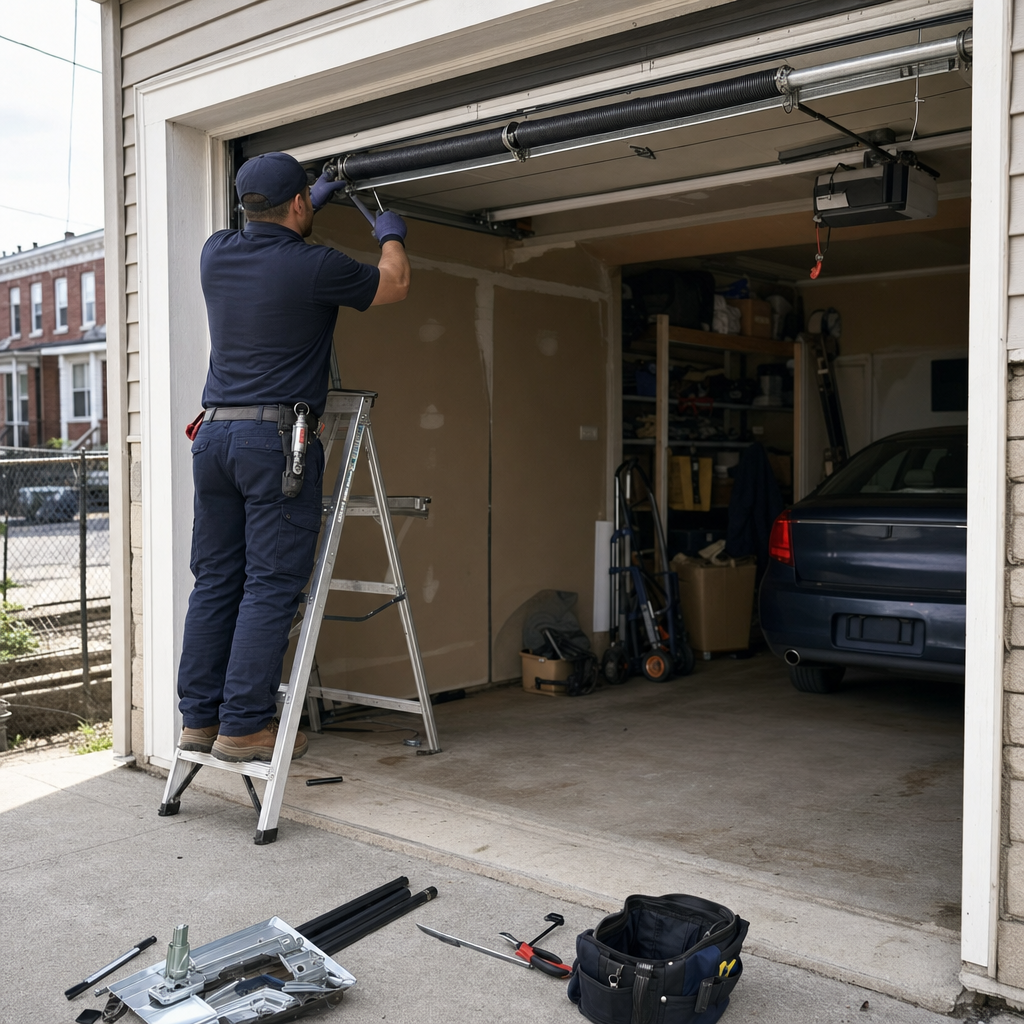
Joseph Taylor shows up personally to every estimate, and one of the first things he assesses is whether the existing header and jambs can handle the door you’re proposing. New York City’s building stock spans 150 years of construction methods, and the garage opening that held a lightweight wood panel door in 1987 may not support a modern 2-inch thick insulated steel door with glass inserts.
Three structural checks we perform on every New York City site:
- Header condition and span: In pre-war buildings, headers are often timber beams that have dried and checked over decades. A modern insulated door can weigh 150–200 pounds more than the original. We look for sagging, cracking at bearing points, and evidence of previous water infiltration that weakens the wood. In Brownstone Brooklyn, we’ve found headers that were “repaired” with sistered 2x4s that don’t meet current load requirements.
- Jamb plumb and square: Masonry buildings settle. A door frame that’s 1/2 inch out of square will destroy itself in 18 months as rollers bind in the track. We measure diagonals and check for twist. In older New York City construction, we often need to install custom jamb brackets or build out with steel to achieve proper alignment.
- Spring anchor bracket mounting: Torsion springs generate enormous rotational force. The anchor bracket must mount to solid framing, not lath-and-plaster or compromised header material. We’ve seen brackets pulled completely through rotted headers in Queens basements converted to garage use.
Warning sign: If your current door shakes violently when opening, or if the top section visibly bows, stop using it and call for inspection. These symptoms indicate structural mismatch or hardware failure that will cascade into more expensive damage. We work on your brand — Chamberlain, Genie, Clopay, Amarr — but no opener compensates for a frame that’s failing structurally.
The Aggregator App Trap: Hiring Mistakes NYC Homeowners Make
New York City’s density makes it a prime market for national home services aggregators — platforms that dispatch whoever’s available, often without garage door-specific training. In 17 years, we’ve been called to fix the aftermath of these dispatches more times than we can count.
Specific failures we’ve corrected:
- A “handyman” from a popular app installed a new Chamberlain opener on a 14-foot high door in a Morningside Heights co-op without checking the rail length. The opener couldn’t fully open the door, and the homeowner paid twice — once for the wrong install, once for us to remove and replace with the correct rail extension.
- A Park Slope homeowner hired through an aggregator for a “spring replacement.” The technician replaced one of two torsion springs, didn’t check wire size or drum balance, and the door crashed two weeks later, bending the top section beyond repair.
- A Staten Island contractor filed no DOB permit for a door replacement in a designated flood zone, triggering a stop-work order and $2,400 in penalties that the homeowner — not the contractor — became responsible for when the company disappeared.
What to verify before hiring in New York City:
- Ask if the person quoting is the person performing the work. At Matrix Garage Door Repair New York, Joseph Taylor is the owner and lead technician — the voice on the phone is the hands on your door.
- Request proof of DOB familiarity for replacement projects. Any contractor who dismisses permit questions or says “we’ll figure it out later” is preparing you for a violation.
- Confirm brand-specific training. Our technicians are trained on eight major brands — LiftMaster, Chamberlain, Genie, Clopay, Amarr, Wayne Dalton, Craftsman, and Raynor — meaning we diagnose rather than guess.
- Check that insurance certificates can name your building as additional insured, a standard co-op requirement that fly-by-night operators can’t accommodate.
411 neighbors have trusted us with their garage doors across New York City’s five boroughs. That trust is built on showing up, doing the work correctly, and being reachable afterward — not on being the lowest bid in an app queue.
A Realistic Maintenance Schedule for New York City Conditions
National garage door maintenance guides suggest annual service. In New York City, we recommend a modified schedule that accounts for environmental stressors that don’t exist in the reference data.
Semi-annual inspection (March and November recommended):
- Visual spring check for rust pitting, coil separation, or binding. In coastal neighborhoods, we see corrosion accelerate after winter salt exposure — March is the critical catch point.
- Roller and hinge lubrication with silicone-based product, not WD-40 which attracts grit. In Manhattan’s particulate-heavy air, this matters more than in suburban settings.
- Track alignment check — freeze-thaw shifts building mass subtly, and track brackets loosen over time.
- Weather seal inspection for cracking and compression set. A failed bottom seal in November means road salt and meltwater enter all winter.
- Opener force and limit settings test. Cold weather thickens lubricants and changes spring torque; settings that worked in September may strain the opener in January.
Annual professional service:
We perform torsion spring balance testing with a calibrated scale, cable wear inspection with magnification for strand fraying, and opener safety reversal verification with both the standard 2×4 test and infrared sensor alignment. In high-cycle buildings, we upgrade this to bi-annual.
After major weather events:
New York City’s coastal flood zones and wind corridors mean post-storm inspection is prudent. After Hurricane Ida’s remnants flooded basements in 2021, we replaced dozens of water-damaged openers and corroded bottom fixtures that standard maintenance schedules wouldn’t have caught in time.
When to Repair vs. Replace: A NYC Decision Framework
From a broken spring to a full new door, the decision calculus differs in New York City because of factors that don’t appear in generic repair-or-replace flowcharts.
Repair is usually correct when:
- The door is under 12 years old and the failure is isolated to springs, cables, rollers, or one damaged panel.
- The structural frame is sound and the door is reasonably well-insulated for its age.
- You’re in a co-op with limited alteration windows and need a faster solution than board approval allows.
- The opener failure is electrical (circuit board, capacitor, gear set) and the rail and motor are otherwise sound. We service Genie, Chamberlain, and other major opener brands — often the fix is a $180 part, not a $650 replacement.
Replacement becomes the better investment when:
- The door is pre-1993 and lacks modern safety features (automatic reversal, photo-eye sensors). Insurance and liability considerations favor upgrade.
- Multiple panels are damaged or the insulation is degraded — common in doors that have absorbed decades of New York City humidity cycles.
- The structural frame requires rebuilding anyway. At that point, the incremental cost of a new door is modest compared to frame work plus re-hanging an old door.
- You’re paying for repeated service calls. We’ve seen homeowners in Astoria and Washington Heights spend $1,800 on cumulative repairs over three years when a $2,400 replacement would have ended the cycle.
NYC-specific replacement consideration: If your building is in a historic district or has LPC (Landmarks Preservation Commission) oversight, replacement may require materials or designs that cost 30–50% more than standard options. Factor this into your decision — and start the approval process before the door fails completely.
For homeowners considering full replacement, garage door installation in Buffalo follows similar climate logic, though New York City’s density and board requirements add layers that upstate projects rarely face.
Common Mistakes to Avoid
- Buying a door before board approval. In New York City’s co-op and condo market, this is the most expensive error we see. That custom-order door with a 6-week lead time becomes unreturnable warehouse furniture.
- Ignoring the wind load map. Coastal zone doors need higher ratings. The $200 you “save” on a lower-rated door disappears when DOB rejects the installation or the door fails in the first major storm.
- Hiring based on app-star rating alone. A 4.9 rating from 23 suburban window-washing jobs doesn’t translate to garage door expertise in a 1920s Flushing garage with a sagging timber header.
- Installing residential hardware in high-cycle buildings. The spring that lasts a decade in a single-family home fails in two years when 15 households share it. Commercial-grade hardware pays for itself in avoided emergency calls.
- Neglecting the opener-door match. A 3/4-horsepower opener on an 18-foot wide insulated door in a Long Island City live-work space will burn out prematurely. We calculate actual door weight and cycle demand before specifying opener capacity.
- DIY spring work. Torsion springs store lethal energy. We don’t provide step-by-step instructions because the injury risk is genuine and the calibration requirements are precise. This is trained-professional work, period.
- Forgetting the permit. New York City DOB requires permits for door replacements that alter the opening or involve structural work. Unpermitted work can block sale or refinance, and the correction costs exceed the original permit fee by orders of magnitude.
When to Call a Professional
Call when the door won’t open or close, makes grinding or popping sounds, hangs unevenly, or reverses unexpectedly. Call before winter if your springs are showing rust or your weather seal is cracked — preventive service in October beats emergency service in January. Call if you’re considering replacement and need an honest assessment of whether your frame can handle modern door weights, or if you need documentation for co-op board submission.
Matrix Garage Door Repair New York offers free estimates in New York City — call (888) 402-9497. Joseph Taylor shows up personally, assesses your specific building conditions, and gives you numbers you can use for board approval or budget planning. From a broken spring to a full new door, we handle the scope without passing you to subcontractors or third-party parts suppliers.
If you’re in Western New York and need parts for a self-diagnosed repair, garage door parts in Buffalo covers our supply operation there — though for safety-critical components like springs and cables, we still recommend professional installation.
Frequently Asked Questions
Standard spring replacement in New York City typically runs $280–$420, cable replacement $180–$260, and opener repair $200–$380 depending on parts. Full door replacement ranges from $1,800 for basic steel to $4,500+ for custom insulated or historic-district-compliant doors. Co-op buildings may add $400–$800 for board-required contractor documentation and insurance riders. Call (888) 402-9497 for an exact quote — estimates are free.
Yes, for most spring, cable, and opener failures we offer same-day emergency garage door service when called before early afternoon. Parts availability for older or proprietary systems may extend to next-day. We carry springs, cables, rollers, and opener components for all eight major brands we service — Chamberlain, Genie, Clopay, Amarr, and others — which enables faster resolution than contractors who must order parts.
DOB requires a permit for any door replacement that alters the opening dimensions, involves structural modification, or occurs in a designated flood zone. Purely in-kind replacement (same size, same location, no structural work) may not require permitting, but we verify this case-by-case. Unpermitted work can complicate future sale or refinancing. We handle permit filing as part of our installation service when required.
Insulated steel with composite overlay performs best for most New York City applications — it handles thermal cycling without the maintenance demands of wood, resists salt-air corrosion better than bare steel, and provides R-12 to R-16 insulation values suitable for attached or conditioned spaces. For historic district requirements, aluminum with wood-grain finish offers a compliant alternative with lower maintenance than genuine wood.
A properly specified and maintained door should last 15–20 years in New York City’s climate. We regularly see doors fail at 7–10 years due to wrong hardware grade for cycle count, inadequate insulation spec for thermal stress, or salt-air corrosion in coastal zones. The 17 years of garage door problems we’ve solved in this market confirms that material selection matters more than brand marketing.
Repair is cheaper for isolated failures in doors under 12 years old with sound frames. Replacement becomes more economical when cumulative repair costs exceed 60% of replacement cost, when safety features are obsolete, or when the frame requires rebuilding anyway. We provide both numbers on every estimate so you can make the comparison with actual New York City pricing. Call (888) 402-9497 — we’ll assess your specific door and give you both scenarios.
The Bottom Line
New York City’s garage doors fail faster than national averages predict because national averages don’t account for freeze-thaw cycling, salt-air corrosion, co-op board constraints, and structural loads from century-old construction. The homeowners who avoid premature failure match their materials to local conditions, verify structural capacity before upgrading, navigate board approval before ordering, and hire specialists who understand DOB requirements rather than whoever tops an app search. 17 years of hands-on work across all five boroughs has taught us that specificity beats generic advice every time — and that showing up personally, with the right parts for your brand, is the difference between a fix that holds and a callback that costs you twice.
Written by Joseph Taylor, Owner & Lead Technician at Matrix Garage Door Repair New York, serving New York City since 2009.